The defence and security sector needs more than weapons systems. It also needs the materials, technologies and manufacturing expertise that keep critical operations running.
This means that traditional industrial companies may have more to offer the defence market than they realise.
For Finnish company miniFactory, the opportunity was found in existing technology. For more than 15 years, the company has developed high-performance polymer 3D printing technology for demanding industrial manufacturing. Defence was one of the potential target markets, but the technology was not originally developed specifically for it.
A few years ago, customer enquiries and initial projects began to show growing demand for the technology in the defence sector as well. In particular, the availability of spare parts, security of supply and local manufacturing emerged as key needs.
– Defence was one of our target markets, but it was only through customer projects that we saw concretely how well our technology could address the needs of the sector, says
Riku Hietarinta, Chief Development Officer at miniFactory.
The customer is not looking for a 3D printer
miniFactory came to a simple realisation: the customer is not really looking for a 3D printer. They are looking for a solution to a problem. A spare part may take months to deliver. It may no longer be manufactured at all. Or certain parts may need to be produced in-house, on demand.
In such cases, the printer itself is not the key issue. What matters is the ability to manufacture the required parts in a controlled and repeatable way, close to where they are needed.
– Start with the problem, not with whether your product looks like something that belongs in the defence industry, Hietarinta advises.
In the defence sector, decentralised manufacturing and digital spare parts production can improve parts availability and security of supply while supporting operational capability.
So this is not simply about 3D printing individual parts. It is about manufacturing capability: being able to produce the parts that are needed, where they are needed.
The defence market goes beyond weapons systems
A broad ecosystem operates around the defence industry. It needs technologies, materials, software, manufacturing expertise, maintenance and logistics – and much more.
This means companies do not necessarily need to develop an entirely new product to enter the market. The opportunity may already lie in existing technology, when it is viewed through the needs of a new customer and operating environment.
In addition to 3D printing technology, miniFactory’s solution combines materials expertise, quality assurance, training, commissioning and ongoing support. The aim is to give customers the capability to manufacture the parts they need in a controlled and repeatable way.
Practical use cases have also emerged in the international defence industry. miniFactory’s technology is being used, for example, in the Rheinmetall UK Challenger 3 programme.
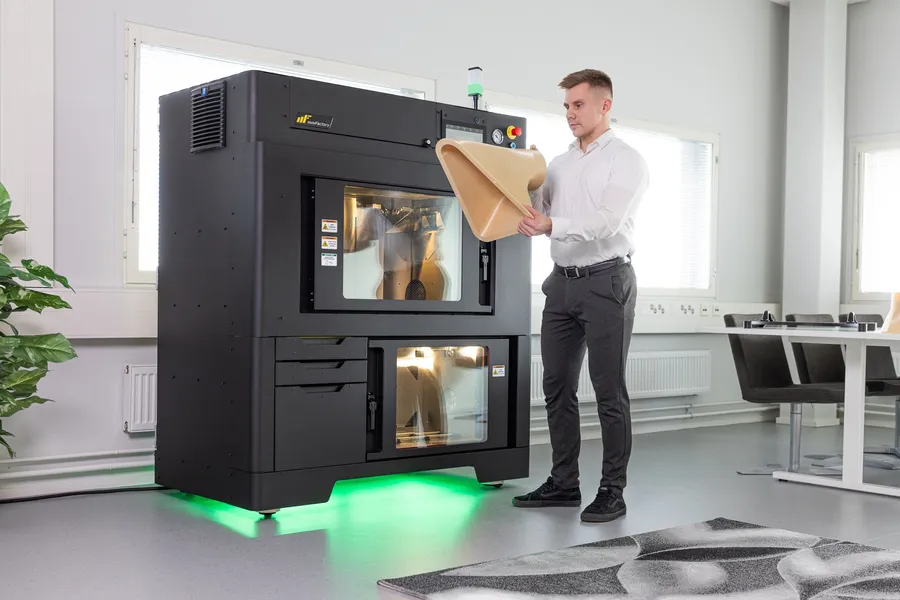 Riku Hietarinta, Chief Development Officer at Finnish industrial 3D printing manufacturer miniFactory, sees defence opportunities in existing technology and capabilities.
Start with the problem, then look at the technology
miniFactory has deepened its understanding of the defence market through discussions, testing, use cases and customer projects. Along the way, it has become clear that many fundamental industrial challenges are familiar in the defence sector as well: reliability, availability, maintainability and cost.
The operating environment does, however, bring its own requirements. Cybersecurity, documentation, supply reliability and the long-term usability of solutions are particularly important.
At Arctic Lion, miniFactory wants to challenge Finnish industrial companies to look at their existing expertise from a new perspective. Entering the defence market does not necessarily require a new product or an entirely new business.
– If we can work together with a customer or partner to identify a real use case and define a concrete next step for testing it, then we have succeeded, Hietarinta sums up.
Come and discover new use cases
At Arctic Lion, miniFactory will host a session on the use of industrial 3D printing in the defence industry and demonstrate through concrete use cases what decentralised manufacturing, digital spare parts production and high-performance materials can mean in practice for defence organisations.
Perhaps the most interesting question is not:
What could we manufacture for the defence sector?
but:
What could our existing expertise solve in the defence sector?
What could your expertise solve? Find out at Arctic Lion.
Register for free